

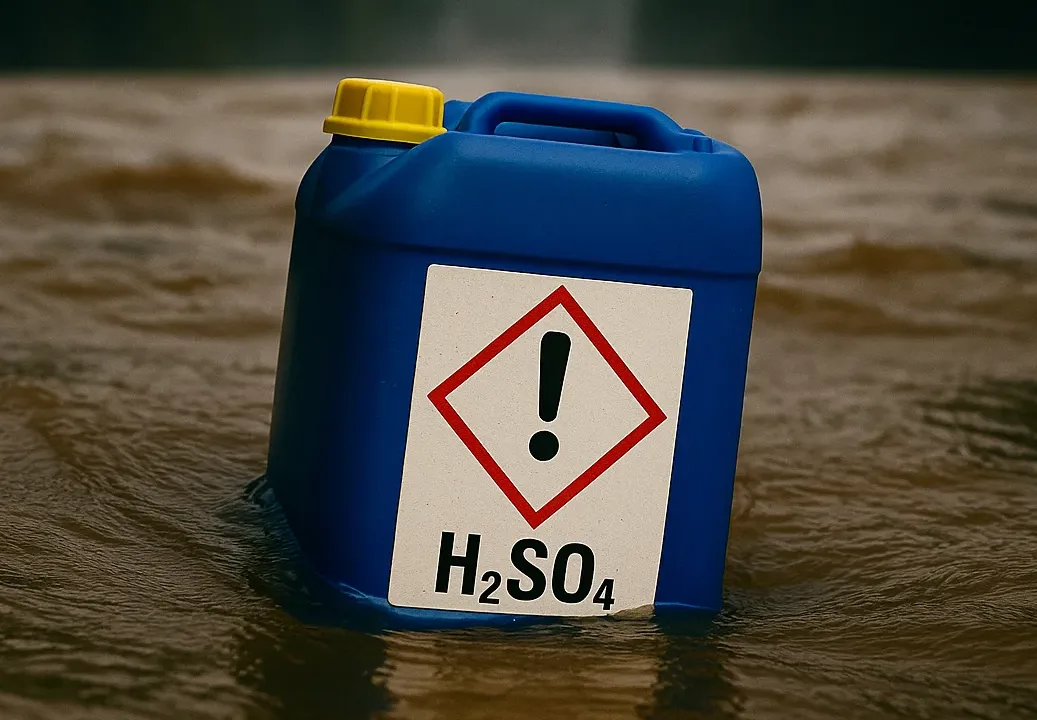
What is H2SO4? H2SO4 (sulfuric acid) is a strong inorganic acid widely used in the production of fertilizers, batteries, metal cleaning, chemical intermediates, and in some industrial pH adjustment steps.
sulfuric acidCAS 7664-93-9, formula H₂SO₄. Commonly found in concentrated form in B2B products.98 % and lower concentrations as per COA; batch COA/MSDS documentation provided upon request.
- H2SO4 = sulfuric acid — a strong, hygroscopic, and highly corrosive acid when concentrated.
- Main applications: fertilizers, lead-acid batteries, pickling/metal treatment, basic chemicals, pH/controlled wastewater treatment support.
- Dilution releases significant heat; PPE required; B2B procurement with COA/MSDS — soft CTA Loc Thien on request.
When technicians or procurement ask "What is H2SO4?" / "What is sulfuric acid?", they usually need to know the full name, CAS number, commercial concentration, properties (hygroscopic, corrosive), industry applications, dilution safety, and how to obtain a price quote. This article provides a practical summary for you to compare with MSDS/COA — it does not replace the factory's internal SOP.
What is H2SO4 (sulfuric acid)?
H2SO4 is the formula of sulfuric axit (also known as sulfuric acid). Common English name: sulfuric acid.
Under normal conditions, commercial sulfuric acid is fluidIt is colorless to slightly viscous when thick. This is a fundamental chemical in the chemical industry: it is both a strong acid and has the ability to... water absorption and — at high concentrations/temperatures — exhibit significant oxidizing properties.
- This is the model: H₂SO₄ / H2SO4
- CAS: 7664-93-9 (Matching MSDS/COA; remains unchanged regardless of solution percentage)
- Common commercial form: special ~98 % w/w; more diluted intermediate percentages as needed.
- Key properties: strong dibasic acid (H⁺), hygroscopic, releases a large amount of heat when mixed with water, corrosive to skin, eyes, and many metals.
Reference specifications
The table below shows a common technical framework. Acceptance values are taken from... COA for each batch.
| Targets | Reference value |
|---|---|
| Name / alias | Sulfuric acid, sulfuric acid, H2SO4, sulfuric acid |
| Formula | H₂SO₄ |
| CAS | 7664-93-9 |
| Commercial concentrations | Typically concentrated at ~98% w/w; diluted according to COA (70%, 50%… depending on the order) |
| Condition / Appearance | Liquid solution; colorless to slightly viscous when thick; highly hygroscopic. |
| Acidity | Strong acid; dissociates in two steps (H⁺ / HSO₄⁻ / SO₄²⁻) |
| Corrosion / Water absorption | Harmful to skin, eyes, many metals and organic materials |
| Common packaging | HDPE cans, IBCs, tank trucks (according to supplier and delivery route) |
| B2B Profile | COA per batch; MSDS; packaging specifications and delivery conditions |
Upon receiving the goods: check the seal, concentration label, batch number, and compare with the COA. Any unusual cloudiness or foreign matter — isolate the product and consult a technician before transferring it to the production tank.
Key features to remember
- Strong acids: Alkali neutralization is exothermic — controlled infusion and dilution.
- Moisture absorption / water absorption: Concentrated acid absorbs water from the air and many organic compounds — keep tightly sealed, store in a dry place.
- Dilution releases a large amount of heat: always pour acid into water (Slowly, stirring), do not pour water into concentrated acid.
- Corrosive: Skin, eyes, respiratory tract (mist/smoke); metals if compatible materials are not available.
- Oxidation (concentrated/hot): Do not treat H2SO4 "just like dilute HCl" in all processes.
Common industrial applications
| Industry/Process | The role of H2SO4 | Purchase notes |
|---|---|---|
| Fertilizer | Acidification intermediate / related superphosphate stream | Concentration and impurities according to factory formula. |
| Lead-acid batteries | Electrolyte after dilution according to the battery process | Not all batches of CN = battery grade by default. |
| Metal / cleaning | Rust removal, surface cleaning | Control concentration, temperature, and time; treat the wastewater tank. |
| Basic chemicals | Acidifying agent, intermediate, dehydrating agent | Impurities can be critical depending on the product. |
| Water/Wastewater Treatment | Lower the pH and neutralize the alkaline flow (when H2SO4 is selected in the procedure). | Add sulfate; compare HCl to SOP. |
| Textile / Other Industries | pH adjustment, several treatment steps | Compare grade and factory records. |
If you are choosing between two strong acids, you may want to check out the comparison of HCl and H2SO4 on the same site (anion, corrosion, operation) — and then refer to the SOP before switching acids on the production line.
Concentration and commercial packaging
Industrial H2SO4 batches are commonly found in the following form: concentration ~98% To optimize the transport of acid content, it is then diluted at the point of use. Some orders are delivered with intermediate concentrations as per the contract.
- ~98% (concentrated): Inventory management and delivery of tanks/IBCs; blending at the plant according to SOP.
- Dilute/Intermediate: When a ready percentage of work or risk reduction is required for on-site mixing, obtain the correct COA.
- Specific grade: Batteries, electronics, etc., may require strict impurity control — not every industrial batch will meet this standard by default.
When requesting a price quote, please include: target concentration, packaging (can/IBC/tank), delivery location, monthly volume, and a request for a COA/MSDS.
Safety and storage
| Category | Practical recommendations |
|---|---|
| minimum PPE | Safety glasses/face shield, chemical-resistant gloves, acid-resistant apron/coat, closed-toe shoes; respiratory protection in fog/smoke conditions. |
| Storage/Tank | Cool, well-ventilated, spill-collecting tray/shrine; airtight lid (moisture-wicking); keep away from strong alkalis and incompatible materials. |
| Container | Cans/IBCs/specialized tanks according to concentration; concentration label + corrosion warning. |
| Dilution | Acid in waterStir slowly; control the heat. |
| Contact incident | Rinse thoroughly with clean water for several minutes; eyes: rinse continuously and seek medical attention — according to the batch MSDS. |
| Spill / overflow | Isolation, absorption/neutralization according to factory SOP, proper waste collection. |
Always prioritize MSDS of the batch being usedThis article does not replace the plant's full emergency response procedures. Further instructions on handling H2SO4 acid spills can be found on the site if operational guidance is needed.
Supplying industrial H2SO4 (soft CTA Loc Thien)
Industrial sulfuric acid H2SO4 (CAS 7664-93-9) for factories and industrial parks: pricing based on requirements, COA/MSDS documentation per batch, packaging in cans, IBCs, or tanks depending on delivery route.
- Main product page: Industrial sulfuric acid H2SO4 — Loc Thien
- Acid category: Loc Thien Industrial Acid
- Technical/Purchasing Hotline: (+84) 979 891 929
We don't list retail prices publicly on the website — you submit your specifications (concentration, yield, location) to receive a quote on request that's tailored to your operation.
Top Q&A
What is H2SO4 and what are its other names?
H2SO4 is sulfuric acid, a strong inorganic acid. English: sulfuric acid; CAS 7664-93-9In industry, you work with solutions of varying concentrations, often encountering concentrated solutions (~98%).
What is the CAS value of H2SO4?
The standard CAS is 7664-93-9The percentage concentration varies by batch, but the CAS number on the MSDS/COA remains 7664-93-9 for sulfuric acid.
What are the common concentrations of industrial H2SO4?
Commonly encountered forms concentration ~98% w/w for delivery and inventory, then blended according to SOP. Some orders are delivered at pre-diluted/intermediate concentrations. Acceptance is based on COA.
How do H2SO4 and HCl differ when choosing an acid?
Both are strong acids but differ in anions (SO₄²⁻ vs Cl⁻), hygroscopic/oxidizing properties (concentrated H₂SO₄ is more prominent), corrosiveness, and process binding. Always consult the factory's SOP before changing acids on the production line.
Can H2SO4 be used in wastewater treatment?
It is possible — mainly for Lower pH / neutralize alkaline flow When selecting sulfuric acid, it is necessary to account for the addition of sulfate to the effluent; perform jar tests and check that the pump/valve material is acid-resistant.
Are a Certificate of Analysis (COA) and a Material Safety Data Sheet (MSDS) required when purchasing B2B H2SO4?
It is recommended to have a Certificate of Analysis (COA) confirming the concentration and lot specifications; and a Material Safety Data Sheet (MSDS) for safety, PPE, and incident response. Loc Thien provides lot documentation when quoting on request.
How to buy industrial sulfuric acid?
Send your desired concentration, yield, packaging, and delivery point via hotline. (+84) 979 891 929 Or visit the Loc Thien product page in the supply section. Pricing is based on demand; we do not sell individual items from the publicly displayed shopping cart.
What precautions should be taken when diluting concentrated H2SO4?
Always pour acid into waterSlowly, stir, and control the heat. Do not pour water into concentrated acid. Ensure full PPE; the area has a spill tray and is ventilated according to SOP.




Comments are closed